
Chapter 13: The Long & Dusty Road
This is déjà vu. But this time it isn’t the incessant buzzing of flies that’s the issue; it’s the barking of dogs that is absolutely paralyzing. Unable to sleep, I shift around trying to find a position that will bring me peace. The barking is not distant, maybe not even outside. Could it be coming from inside the hotel?
I roll out of bed and exit my room to see if there is anything I might do to salvage another hour or so of sleep. I step into the hotel sitting room. There is no one around and the dogs of course have stopped their discourse now that I am out of bed. On a large-scale map of South America hanging on the wall, I trace my route from Iguaçu Falls to Resistencia and on to Salta. As I cannot go through Paraguay, I must go southwest to Resistencia and then it’s anyone’s guess what route to take northwest to Salta. It does seem like a long way and it looks like I might again cross the Tropic of Capricorn.
A few hours later, still a little groggy from my early start, I meet the hotel owner. “I’m heading to Resistencia today,” I say. “I bought my ticket for the bus ride yesterday.”
“You’re going where? Resistencia? Why would you want to do that?” He looks at me quizzically and gives his head of thick greying hair a shake.
It seems perfectly logical why I want to go there.
“It seems like a fun place to travel to,” I reply. “It’s well away from the city, and I’d like to see that part of the country. I’m going to go from there to Salta.”
“I’m not sure I know anyone who has traveled up there for adventure before,” he responds, clearly perplexed by my intentions, and perhaps doubting my intellectual capacity. But at least he didn’t make air quotes when he said the word “adventure.”
“Well, I have been to lots of distant and remote places before. Maybe it’s part of my DNA to see such things. I hope you can figure out how to quiet the dogs for the sake of your other patrons. Thanks for everything.”
With this, I’m off to the bus station, my backpack feeling a little heavier after the horrific sleep.
On the bus, or rather motor coach, I feel instantly at home. For more than five years in high school I spent my Saturday nights working in a bingo hall. While I didn’t smoke, I felt as though I inhaled dozens of cigarettes per night. I endured lung abuse, collected money, passed out cards, called out the numbers, and verified winning combos for the average wage of 12 to 14 dollars per night. And here it has come full circle. Bingo is back, baby!
I sit in my seat, on an incredibly long bus ride towards the Andes, and watch as the hostess passes out bingo cards to the passengers. My mind wanders aimlessly; I half expect this bus to do the same. Movies show on the large televisions hanging over the seats. I understand nothing of what is being said, although one movie I recognize as an English-language film with Portuguese and Spanish subtitles.
The bus crosses from Foz do Iguaçu in Brazil to the Argentinian side of the Falls, Puerto Iguaçu. From here we seem to quickly enter farmland. Large fields are speckled with cows and bulls of all shapes, sizes, and colors grazing on lush green grass. Every now and then, one looks up and stares blankly at the bus.
I talk to the woman next to me. She’s in her sixties, I guess, and her English is a surprise to me, basic but good enough for her to get her thoughts across. She’s going to visit family, she says, adding that she’s heard Canada is very nice; then she asks why I want to visit such desolate places as Salta and Resistencia? I smile back and proclaim that I’m an adventurer and explorer, off to find myself. Perhaps this satisfies her curiosity, but it’s more likely she has no desire to further engage with me. In any case, our conversation is at an end.
At some point in the evening my neighbor departs, after which I have the seat to myself the rest of the way. When we arrive in Resistencia at 8:30 the following morning, I step off the bus and, going to the ticket agent, recall the conversation I had with Dani, Marianna, and Diego before we parted.
“Un billete para Salta, por favor,” I say, smiling at my use of Spanish, even in this limited capacity.
Unfortunately, my triumph is short-lived. The agent replies in a barrage of Spanish, which after the all-night bus ride is just too much to decipher. Sheepishly I ask if he would mind writing it down, which he gladly does. Thus I discover that my ticket costs 306,000 australs, which is about $32, and the bus leaves at 5 p.m. After handing over my money, I check my backpack and go off to explore.
“Well, let’s see what this outpost has to offer,” I think to myself, feeling liberated once more by having got rid of my backpack. It’s a hot morning and I stop at a cafe not far from the bus station for a little breakfast jug of zumo de naranja (orange juice $1) and a roll and then continue to the bank to convert some money. To my dismay, cashing two $50 travelers checks entails a hefty $8 commission charge. These types of fees are difficult to fit into the budget.
I spend the rest of the morning walking about the city. The population of Resistencia is about 200,000. It’s known as the city of monuments with more than 100 marble sculptures and works of bronze, steel, and wood. I check out the public art and monuments in the streets around the city center and then wander around the local parks. In the core of the town is the Plaza 25 de Mayo. If it is the pitcher’s mound, a quartet of parks flank it like the bases on a ball diamond. Each park is a kilometer or so from the next, so running the bases here nets a pretty good workout.
Around 12:30 p.m., Resistencia turns into a veritable ghost town. Suddenly, people vanish from the streets, while shops, cafes, bars, and even the restaurants lock up like it is the end of the day. Given the heat, I can understand the reason for the siesta. Luckily, I purchased some groceries before everything shut down, so enjoy a pleasant afternoon in Plaza 25 de Mayo, where I keep my eye on the statue of General José de San Martín while eating lunch, writing postcards, and recovering from the hefty walk.
The town springs back to life shortly after 3:30 and I am ready for a little more urban exploration before the bus at 5. In contrast to the negative travel critiques I previously received, I am happy for this stop in this city that got its name from the resistance to colonization put up by its early inhabitants. Resistance to unpopular opinions too, I guess. I might even come back.
The bus departs on time, motoring over a smoothly paved road for a couple of hours until we stop for a dinner break. The next twelve hours after dinner are far from smooth. We jiggle around in our seats as the bus navigates the pockmarked road, which is more like a track. Small brush fires burn close to the road and the smoke chokes my throat. It feels as if the heat from the fires is radiating into the bus, although that could also be the poor air circulation. Along this flat terrain I watch myriad birds assemble and disperse outside my window: hawks, ducks, egrets, and others. For a while we follow behind a truck and I watch as it zigzags across the road, dodging huge holes and crevices and our bus follows suit—the driver afraid, almost, to let the truck out of sight lest he has to find his own way through the obstacle course. For a couple hours this is mildly entertaining, but eventually I see why there is such resistance to traveling to these remote spots.
Towards the end of my second all-night bus ride, I’m longing for a shower. Night turns into day, the morning wrestling me awake as we climb into the highlands, ascending above the 1,000-meter mark. It’s 9:30 a.m. when we pull into Salta. It’s a tough, rugged-looking place sitting in a valley, its gruff edges incongruous with the elegant beauty of the mountains rising around it.
I review my plan with the aid of the Lonely Planet guide. It is important to know where to go when getting off the bus to minimize the likelihood of someone taking advantage of me. I walk smartly into the little terminal and assess my options for finding a place to sleep. A huge church looms over the terminal, and I watch the bus pull away.
I head straight for the Residential San Jorge, a refreshing twelve-block walk, albeit loaded down with my backpack. I really like the room, which costs $5 and is on the second storey of an old wooden building, with clean timber floors, a big bed, and faded oil paintings on the walls. The owner, a craggy-faced man in his fifties, introduces himself as Jorge.
“Come over here, I can show you with the maps.”
Jorge’s English is very good, but I try to answer him in Spanish.
“Quiero, um, el carta.” My Spanish mixes with French and I forget a verb and probably reference a menu instead of a map.
Jorge smiles and puts his arm around my shoulder. “I appreciate the effort, my friend. Let’s speak in English, however, to make sure you do not misunderstand something I say.” His arm falls from my shoulder and he pulls out several folded maps. “The first thing you must understand,” he continues, “is that this whole area around Salta, northern Argentina, is one of great natural beauty. Salta is actually called Salta la Linda, or ‘Salta the Beautiful.’”
My first impression of the place is a rough-hewn urban area contrasting starkly with its surroundings.
Jorge tells me about the things I can do in the area, including taking the Train to the Clouds and lots of hiking. “There are the salt flats,” he says, “but those aren’t spectacular like the mountains for me. Where I would go if I didn’t have much time is Cachi. It is beautiful, like Colorado or Arizona.” Jorge’s finger traces the route to Cachi on the map. “And then down to Cafayate. You like wine?” he asks.
“Sure,” I reply, “though I’m no connoisseur. I tend to like red more than white.”
“Ah, then you should probably travel from Cachi to Cafayate and go on a wine tour. They have the highest vineyards in the world. You know, highest elevation.” Through his thick accent and speedy delivery I am still able to keep up in my native language.
“OK, that sounds like a plan. I really appreciate the pointers,” I say. “Think I’m going to take a little siesta and then explore Salta. Thanks again, Jorge.”
After a nap, a shower, and lunch (a ham and grilled cheese sandwich, Coke, and ice cream for $3), I am at the tourist office. The buildings are old and quite beautiful. As it turns out, the Train to the Clouds is not running until April, and the Salta city tour seems a bit pricey. So I set out on the do-it-yourself walking tour and meet seventeen-year-old Hector, who tells me he is already married with a child and in the army. His English is pretty good and we chat for a bit.
“I would be happy to host you where I live at nine p.m.” Hector seems genuine in his invitation and I do not sense anything amiss.
“Sure, I would love to come and see your home and meet your wife,” I reply. Looking at the directions he writes down, I tell him I will see him later.
The rest of my self-directed tour takes in the town. I wander around the 9th of July Square, which is dominated by the main cathedral shrine and museums dedicated to contemporary art and high mountain archaeology. I return to the bus station and purchase my ticket to Cachi. Even though the city is home to more than half a million people, it has a small-town feel to it. There are some nice homes in the neighborhood on the hillside and I imagine living in a place like this. I grab a snack and make sure I am back at the hotel by 9 p.m. to walk to Hector’s.
For a moment I wonder if this decision to go to a stranger’s house is wise. But as I approach Hector is standing there waiting for me. Their baby asleep, Hector and his wife Eva are most hospitable. Their home is small but inviting, sharing a large courtyard with several others. Again, as I step into a low-ceilinged kitchen, I find myself thinking about how I might enjoy living here. I marvel at the simplicity. Hector and Eva are genuine and curious about Canada, taking turns to pepper me with questions about the cold, the snow, what we eat, and what we do for a living. They are excited new parents fully in love with the family experience and each other. I leave around 10:30, my face a little sore from smiling so much.
At a quaint little restaurant I stop for an asado, or Argentine barbecue. The meat is slowly cooked over a grill here, although traditionally it is prepared over an open fire. A young girl, maybe seven years old, helps to clean the tables and serve the patrons. She is full of energy even at this hour of the night, and in spite of the obvious issue with having such a young child working such a job, she is highly entertaining and a joy to be around. After dinner, I return to the hotel to prepare for another day of bus travel.
Next morning, I’m up early to catch the bus to Cachi for the connection to Cafayate. Jorge walks me and a Brazilian named Ricardo to the ticket agent’s home. Before leaving again he implores us to be safe and to see as much of Northern Argentina as possible. The ticket agent loads us into her car and proceeds to drive us to the bus. I chuckle to myself about this strange way of doing things, but am grateful for the assistance.
With a front row seat, I introduce myself to those next to me, a couple from Austria—Robert and his fiancée Bridget. Robert’s curly brown hair and dark complexion contrast with Bridget’s straight blond hair and fair skin. Sitting down in the seat, she looks to be inches taller than him. They look to be roughly my age and are obviously in love. As we chat a little, they tell me of their creative arts backgrounds and how appreciative they are of the artistic and visual experiences of travel in Argentina.
We join Ruta Nacional 40 for the climb through the mountains. It’s beautiful, although the road leaves much to be desired. Front row seating, I realize, has its pros and cons, which become blindingly obvious as the journey unfolds. As the bus teeters on the edges of cliffs and washouts, I have my heart in my mouth. The iconic road is only sporadically paved, but its rugged nature, its status as the longest road in Argentina, and the role it plays in uniting the country make it a symbol of national significance. Spectacular views appear like mirages out of dry, dusty valleys far below. The stratification in the rocks—always a spur to my sensory faculties—is dramatic, and I twist in my seat to study the striking hues of red and ochre in the cliffs that soar above our heads. On a couple of occasions the driver stops to allow us to take photographs and I study the lines in the rocks, some as perfect as if part of an architectural drawing, others moving up and down like a sound wave echoing between mountain ranges. Jorge is correct: the geology is similar to that of the Arizona desert and I feel oddly at home right here in this Andes region.
We stop for lunch at a pig and sheep farm. It’s an interesting choice. We’re now at something like 3,600 meters and it’s cold with bone-chilling winds that howl through the passes, causing us to eat quickly and hastily retreat to the shelter of the bus. We continue to climb into the Cachi range of mountains, which lie within the Andes. My hands clench as we negotiate dramatic switchbacks, tight curves, absent guardrails, and other rollercoaster thrills.
Once in Cachi, I get together with Ricardo and the Austrians and we survey our situation. It is a small town of about 4,500 people in the far northwest of Argentina. Transportation options are limited to begin with, but we then discover that our options for getting to Cafayate by bus have struck a further snag. The bus from Cachi to Cafayate does not run on Thursday and there’s a rumor that this week a transit strike after Thursday is planned, which will affect buses and trains across the country.
There are worse places to be stuck. Cachi is a magnet for mountain climbers owing to the presence nearby of 5,000-meter-plus ranges and relatively mild temperatures. The Spanish colonial architecture looks like a movie set, the homes built in traditional adobe style with a proliferation of whitewash. At first glance, a flat-faced church in the town square appears to be a clapboard movie set front, and I fully expect to find some flimsy wooden frame holding it up from behind. But there is much more to this important place of worship. Dating back to the 1600s, it is one of the oldest buildings in this area, just a few hundred years removed from the time the Incas ruled the land. The surrounding environment is a feast for the eyes with colors alternating from steel grey to lush green to rust red and back again with the rise and fall of elevation. The mountains provide a fantastic backdrop to this little settlement nestled in its valley almost 2,500 meters above sea level.
After some discussion, we decide to try and get a taxi or collectivo to Cafayate. From there I hope to be able to connect via transit to Tucumán, where I would route back to Buenos Aires via Salta. It is quickly obvious that there is little chance of a taxi, so we head to a hotel, one of three in the town. The Nevada is not the cheapest, but all of us can get a room here. We have a wonderful grape vine right outside our door, a testament to the horticultural diamond in the proverbial rough, even at this altitude.
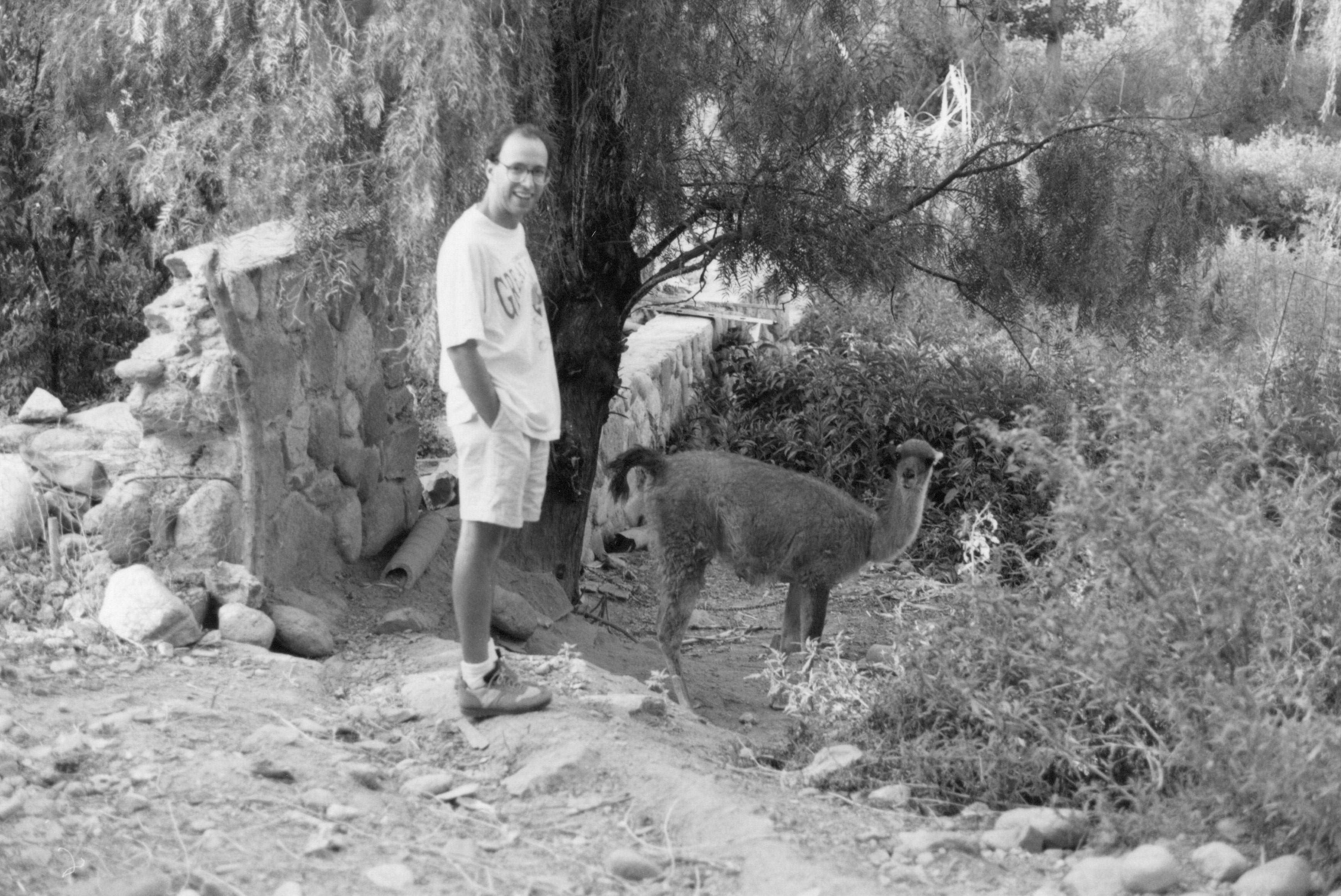
After dumping our backpacks, Ricardo and I go out to explore. In the main street, we duck into a local artisan shop where we learn everything we might need to know about llama, guanaco, and vicuña wool. This is an integrated supply chain operation, and I step out back to have my picture taken with a beautiful guanaco who gives me the smoldering side eye.
Siesta time shuts down the town so I grab a little shuteye myself and then Ricardo and I venture out to a restaurant for pizza and some Salta beer. Afterwards, as we meander through town, some locals give us orange juice which tastes bright and refreshing. Where ice cream is to be had, I have it, and it makes the weather feel not so hot. Back at the hotel, the excellent mix of mountain water and high-altitude hops in the local beer delivers inspiration to write several letters home. All in all it’s been an excellent day, with Cachi proving to be open, warm, and inviting, not to mention full of surprises.
The altitude makes me tired and I sleep in until 8 a.m. Venturing out to find someone to take us with a truck to Tucumán is its own little adventure. I am basically a deaf-mute tag-along as Robert and Bridget do the heavy lifting of approaching people in the streets, following up on leads, and eventually locating a possible option, all in Spanish. Turns out the local handyman wants $150 for the ride. That is too expensive for the four of us, so we see if we can’t find some other travelers with whom to distribute the cost. We ask a young French family, the Blancos, if they are interested and they for some reason don’t find any issue with our plan. We agree to meet at 1 p.m. after deciding that 250,000 australs ($25) each is not so bad.
While waiting, I walk over to the archaeological museum which I find quite interesting, the exhibits including many local artifacts and a particularly well-mummified former inhabitant. At 1 p.m. I am enjoying the sun, swinging in the park with the Blanco’s little girl, Lorena. At 1:45 p.m. a blue and white Chevrolet pick-up rolls up to the park. There is a tarp extending from the cab to the tailgate, and our driver and his assistant jump out to pull the tarp back. This is our ride?
The truck is covered in a white film of dust (and I fully expect I will be shortly as well). We jump in the back for the short drive to our driver’s house where he loads up some gear. Here’s a surprise—his wife, mother-in-law, and three children are coming along for the journey. I wonder where we will all sit. It’s obvious that there are no safety nets here. My hands feel a little sweaty and I suddenly have an unquenchable thirst. I quickly go through the manifest of those who will make the ride. We have a family of six, a family of three, a couple from Austria, a chap from Brazil, and me. That makes thirteen. Lucky thirteen.
Optimistically there are three seat belts. The husband, wife, and mother-in-law are in the front with a toddler. Their other two kids are in the back of the truck with us. So three kids under the age of nine or ten, but they are all polite and well-behaved, although the little boy in the back with us has started vomiting and seems unable to stop. His brother puts his arm around him as he retches over the side of the truck, and we attempt to console both of them. The mother stays steadfast in the cab of the truck. The distance to Cafayate is about a hundred miles. Given the loaded truck and what’s certain to be a deplorable road, our driver expects it to be a five- or six-hour drive. Oh boy. I cannot decide if this is one of the most scary, humorous, or exciting things I have done, but it certainly ranks up there with the most unusual.
By 2 p.m. we’re ready to go. The nine of us in the back look nervously at each other as we ease along the dusty town streets. Already my teeth grind on the dirt grit that floats in the air. But the little boy has stopped vomiting and looks quite cheerful, which must count for something. We’re back on the infamous highway 40 and go very slowly. After about an hour, we stop at some roadside ruins that have yet to be fully developed. An hour after that we pull into Molinos, a small town of 4,000 people at 2,500 meters, where we snap photos of beautiful churches and other buildings dating from the 17th century. It seems like a typical little Andean town, with a church in the middle, some kind of government building, and the local hacienda. We are able to stretch our legs in the courtyard of this little inn amidst dark green wooden tables and chairs surrounding a large pepper tree offering shade from the intense sun.
Back on the road, we traverse a landscape of deep red rocks and stark silver boulders jutting out of the earth. It is what I might imagine another planet, or perhaps the moon, to look like. While none of us have relaxed our grip on whatever piece of the truck bed we have attached ourselves to, we’re on an incredible natural high with ever more spectacular views appearing around every hairpin corner.
We pass historical aboriginal ruins with vineyards alongside them. Mountains soar above our heads in all directions. Wide and spectacularly dry riverbeds give way to sand dunes, with signs of great flooding in the past evident in fantastically denuded landforms. Sweeping through barren valleys, a cold wind lashes our faces.
We have a near miss when a car speeds to pass a large bus around a blind corner, forcing our driver to take evasive action. The vehicles are old and it’s almost like being in a time warp, cast back to the 1960s. A bit later, a new Mercedes and then a bright cherry-red BMW race past to bring us back to the present.
Finally, at 8 p.m., we make our way into Cafayate, an artsy town that is home to the world’s highest vineyards, according to Jorge. We cannot find a cheap hotel so we get a double room at the Hotel Emperador on the plaza that includes bath, air conditioning, and breakfast. We enjoy a light dinner of humitas (sugar and raisins wrapped in sweet corn tortillas, yum!) and even some wine-flavored ice cream.
The following morning, after a good night’s sleep, we eat a usual breakfast of bread and fresh fruit and then go out to explore. The town consists of clay houses in earthen tones lined by tiled sidewalks. Old Ford and Chevy pick-up trucks rattle around on bald tires. Images of this San Martin guy pop up everywhere. As the morning unfolds, wonderful music starts playing and the streets fill with people in traditional dress and hordes of tourists. Bridget asks a man what’s going on and it turns out we’re in luck—the Serenata a Cafayate, a famous music festival, is underway.
We soon join in, swaying and dancing and reflecting on the good luck we’ve had to be brought together in this special place (and maybe saying the odd silent prayer that we’ve made it this far at all). The festival goes all night long and we listen to artists young and old as we move about the stadium from the bleacher seats to the dancing crowds. We sample wine offered on small tables and eat barbeque sausages and other cuts of beef and pork pulled straight off the charcoal grills. Finally, a couple hours after midnight, we depart, tired but smiling.
My sleep that night is fitful as I’m preoccupied with thoughts of returning home and finding a job. The restlessness is hard to understand after such a thrilling day, but I put it down to not having a constant travel companion. I miss having someone with whom to share the highs and lows of the journey, who can appreciate the energy and effort required to make it this far. I also miss having someone whose first language is English.
Upon waking the next morning, Ricardo and I are out of the room early to see the town. Breakfast first, though: café con leche and tortillas with marmalada and even a taste of some sweet coyote jam, an interesting concoction of sweet potatoes served with goat cheese. Fortified, I head to the local cambio to change some more money and pay more commission fees.
Interestingly, Salta has its own provincial currency. It’s called “bonus” and the local shopkeepers ask to be paid in australs and give bonus for change. We explore the town and stop into some hotels looking for a room for Ricardo, who wants a cheaper address. I’m weighing up my options; I would like to stay a bit longer, but if we don’t find an inexpensive hotel I will move on. With the Serenata underway, things are pretty booked up.
Back at the hotel, rain looks likely and I enjoy some time chatting with the Blancos and Robert and Bridget join us. We talk through a heavy downpour but then, with the sky clearing, I decide to do some sightseeing and souvenir-hunting. I have to stock up on film and the only option is a roll of 36 exposures for $9. It seems expensive, especially given that I don’t know how old the film is. I eventually cough up the money, out of desperation, and afterwards pay 10,000 australs, or $1, to visit a private archaeological museum where I peruse some interesting pottery and artifacts. In the back is an old colonial museum which houses a 200-year-old pinball machine. At least that’s what it resembles, but the actual purpose of the artefact remains unclear. I grow a little creeped out when I come across some pottery bowls full of various-sized bones and a dozen or so skulls lined up on a shelf. Touching seems to be encouraged. I am seriously suffering from the heebie-jeebies.
Outside the museum I meet up with Ricardo who says a group is trying to arrange an expedition to some ruins. I decline and enjoy one last lunch with him and Robert and Bridget. The Serenata was a great experience, but I’m not up for it for a second night given the likelihood of more rain and suffering as I am with a thick throat from the dusty truck ride. After lunch I spend the rest of the afternoon relaxing in the plaza across the street, watching people and writing about and trying to digest all that has happened in the last forty-eight hours.
Then it’s time to say goodbye to my travel mates and board the 6:30 bus for the three-and-a-half-hour ride back to Salta. It’s another scary journey. We have a near miss on a corner with a very steep drop and I’m on edge the rest of the way. I try to calm my nerves by listening to my Spanish language tape and Tom Cochrane. Thank goodness for my Walkman. Now that I am a seasoned Salta traveler, I buy a ticket to San Miguel de Tucumán for 7,000 australs, or $7, and then, with light rain falling, go and see my good friend at the Residencia San Jorge. Jorge greets me with the same warm smile and inquires how I enjoyed the beauty of the northwest. I tease him that high elevation wine is not good, but concede that the journey exceeded my expectations. I am ready for bed to prepare for the next day’s leg on my route back to Buenos Aires. I find my Campsuds shampoo that I mistakenly left earlier in the week and marvel at how this little win makes me so happy. Familiarity, I guess.
People are out sweeping the streets this morning from last night’s rain. I barely heard anything, but it must have come down—my shoes are soaked from the walk to the bus station. There are no fruit stands open yet, so I nosh on buns and pastries for breakfast and soak in the newspaper headlines that suggest the Iraqis may leave Kuwait and peace may be near. The bus seems quite luxurious with its own service attendant offering candies, sweetened coffee, and pastries, and I feel happy and content as I once again watch the Salta suburbs give way to farmland.
The ride takes us through the foothills of the Andes, although the elevation is still anywhere from 2,000 to 5,000 feet. We follow the road with aged hills on either side, the colors shifting from imposing greys and browns to lush greens and yellows, dotted with brilliant ruby flowers. As we leave the province of Salta and enter Tucumán province, the mountain range Cumbres Calchaquíes comes into view. It is part of a central fault line in the area, jutting out of the earth creating a wonderous mix of stark desert, broad meadows, and dense rainforests.
We pass by the expansive 9th of July Park as we arrive in the city of San Miguel de Tucumán. Disembarking from the bus, I heave my bag onto my back and scan the station for my next steps. Locating a schedule on the wall, I try to find a bus to Buenos Aires.
“Are you looking for a bus or a train?” a man with a French accent asks me as I try to make sense of the schedule.
“I’m looking for either,” I say. “Can I get a train to Buenos Aires from here?”
“I’m afraid not,” he replies. “Well, there are trains that go there, but none today as they are all on strike still.”
The man looks French. Sounds French. Maybe he is French.
“Are you French?” I bravely inquire.
He smiles back. “Yes, I am from Paris.”
I am delighted to meet someone from Paris who will speak English with me.
“Ah. I’m Brian. From Canada. Looking to get to Buenos Aires.”
“Bonjour, Brian, I am Paul Pierre.”
“Where are you heading?” I ask my new French friend with two first names.
“I want to go up north. To the wineries I have heard so much about.”
I laugh. “We are going in opposite directions. I just came from Salta. Stopped in Cachi and Cafayate. I highly recommend both. Although to be honest, I only got to try the Malbec and some wine-flavored ice cream. For some reason we didn’t hit the vineyards.”
I tell him about the Serenata festival and the truck ride and about meeting people and seeing skulls and the terrifying state of the roads. I add that he will love every minute of it. He directs me to the bus counter where he has just procured his ticket to Salta.
“Well, thanks for your help, Paul Pierre,” I say, shaking his hand. “Maybe we’ll run into each other this summer when I get to Paris.”
“Yes, indeed, and thank you Brian for the great tips. I’m not sure I will opt for a ride in the back of a truck, but one never knows what opportunities present themselves on such an adventure. Until Paris!” He pats my back and turns towards the bus lanes to board his ride.
Owing to the train strike, all buses are full except the 10-p.m. overnight to Buenos Aires. I score a discount using my youth hostel card that suggests I might be a student. Saving $11 means a whole day of travel for me, so I am quite happy with the deal. They also let me check my backpack, which feels like a huge deal. I venture into the rain to seek out the Casa Histórica de Tucumán. So much of the history I see here revolves around Argentine independence that I want to check out this fine colonial building and museum where the Argentine Declaration of Independence was issued in 1816. Unfortunately, it’s Saturday and the museum is closed.
I spend the rest of the day around the main plaza admiring the beautiful churches and government buildings, also several grand banks which for some reason seem to shine brightest. Most shops are also closed on Saturday, but I find one where I can buy a souvenir spoon for Mom, some postcards, and food for the overnight bus ride. At twilight I indulge in a dinner of empanadas from a small, family-run carry-out window and afterwards walk a bit more.
Inspired by the images on my postcards, I return to the main plaza to see the government buildings lit up—unfortunately, the lights are not turned on. As I head back to the bus station I encounter some local kids dressed up in gaucho costume, colorful ponchos and long, accordion-pleated pants and high leather boots, playing drums and blowing whistles while waving feathers in unison. Before reaching the bus station, I manage to squeeze in one more ice cream.
Basically, I spend all night and all the next day on the bus. Yippee. The highlights include two movies, Spaceballs with John Candy, and The Evil That Men Do with Charles Bronson, and the bus driver getting lost for one and a half hours in Rosario. Absent a GPS device because, well, they haven’t been invented or at least disseminated to the general public yet, but finally a passenger steps forward and gives directions. We arrive in Buenos Aires at 2:30 p.m., roughly sixteen and a half hours after setting out. By 4:30 p.m., I’m at a hostel.
I recall the varied conversations I had with folks who cautioned me about travel to the desolate and remote areas of Argentina’s northwest. What was missing from these narratives was that the people I would meet, locals and tourists, would have such a positive impact on my experience. I appreciated the sights, sounds, and tastes of the region more than I expected. The whole encounter fit perfectly together like pieces of a puzzle to produce vivid and lasting memories. I couldn’t be more pleased to have proven the naysayers wrong. This has been an adventure that I would not trade for anything.
